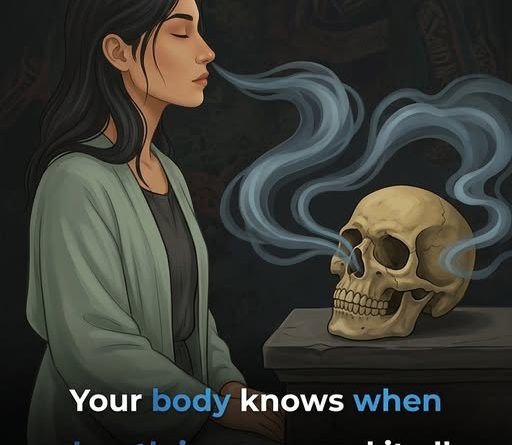
A Study Reveals: Your Body Knows When Death Is Near, And It All Begins In The Nose
The idea that the human body can sense death has long been part of belief and intuition. But recent research suggests there may be a scientific explanation behind some of these reactions.
Grief itself is deeply human.
Losing someone affects the mind, body, and emotions in powerful ways. It can change how people think, feel, and respond to the world around them. But beyond emotion, the body may also react on a biological level.
Scientists have identified certain chemical signals linked to decomposition.
One of them is a compound called putrescine. It forms naturally as the body breaks down and carries a strong, distinct odor.
This is where things become interesting.
Research suggests that humans may subconsciously recognize this scent. Instead of consciously identifying it, the brain reacts automatically—triggering a subtle sense of alertness or discomfort.
In one study, participants exposed to this compound reacted without knowing why.
They tended to move away or become more cautious, even though they couldn’t explain what caused the reaction. This points to an instinctive survival response rather than a conscious thought.
Similar reactions exist in nature.
Animals often rely on scent to detect danger, decay, or predators. Humans appear to share part of this ancient system, even if it operates below awareness.
There’s more.
Researchers have also found that human emotions, like fear, can influence others through scent. Signals released through sweat can make nearby people feel uneasy or more alert.
All of this highlights something important.
The human body is constantly processing information beyond what we realize. Smell, in particular, plays a quiet but powerful role in how we respond to the world.
In the end, it’s not that the body “knows” death is near.
But it may recognize certain biological signals connected to it—long before the mind fully understands what’s happening.