Back to the Future Part II: the predictions that came true
When Back to the Future Part II reached cinemas in November 1989, it sent Marty McFly and Doc Brown forward in time to 21 October 2015.
That date has now come and gone, so how did the film’s vision of the future hold up? Surprisingly well, in some ways.
The film was directed by Robert Zemeckis and starred Michael J. Fox as Marty and Christopher Lloyd as Doc.
What it got right
Video calls. In one scene, a character takes a video call on a large screen at home. Today, millions of us talk to family on video every day using phones, tablets and laptops.
Paying with your fingerprint. The film shows a character paying for a taxi with his thumbprint. The BBC has pointed out that today’s app-based taxis and fingerprint-secured payments are not far off.
Smart glasses. Marty’s son wears high-tech glasses. Since then, several big technology companies have launched smart glasses and headsets.
Flat-screen TVs. The McFly family has a large, thin TV on the wall, showing several channels at once. Wall-mounted flat screens are now in many homes.
Voice control. Characters talk to their TVs and gadgets. Voice-controlled TVs and smart speakers are now common.
Drones. A camera drone appears briefly in the film. Drones are now used by news crews, hobbyists and even delivery companies.
Clever clothing. Marty’s self-drying jacket and self-lacing trainers looked like pure fantasy. Nike even filed a patent for self-lacing shoes, the BBC reported in 2015.
What it got wrong
Some predictions missed the mark, and a few are rather funny today.
- Flying cars. “Where we’re going, we don’t need roads” remains a dream. Flying cars are still not part of normal life.
- Fax machines everywhere. The McFly home has several fax machines. Few homes have even one today.
- No smartphones. Perhaps the biggest miss. Nobody in the film carries a phone that fits in a pocket.
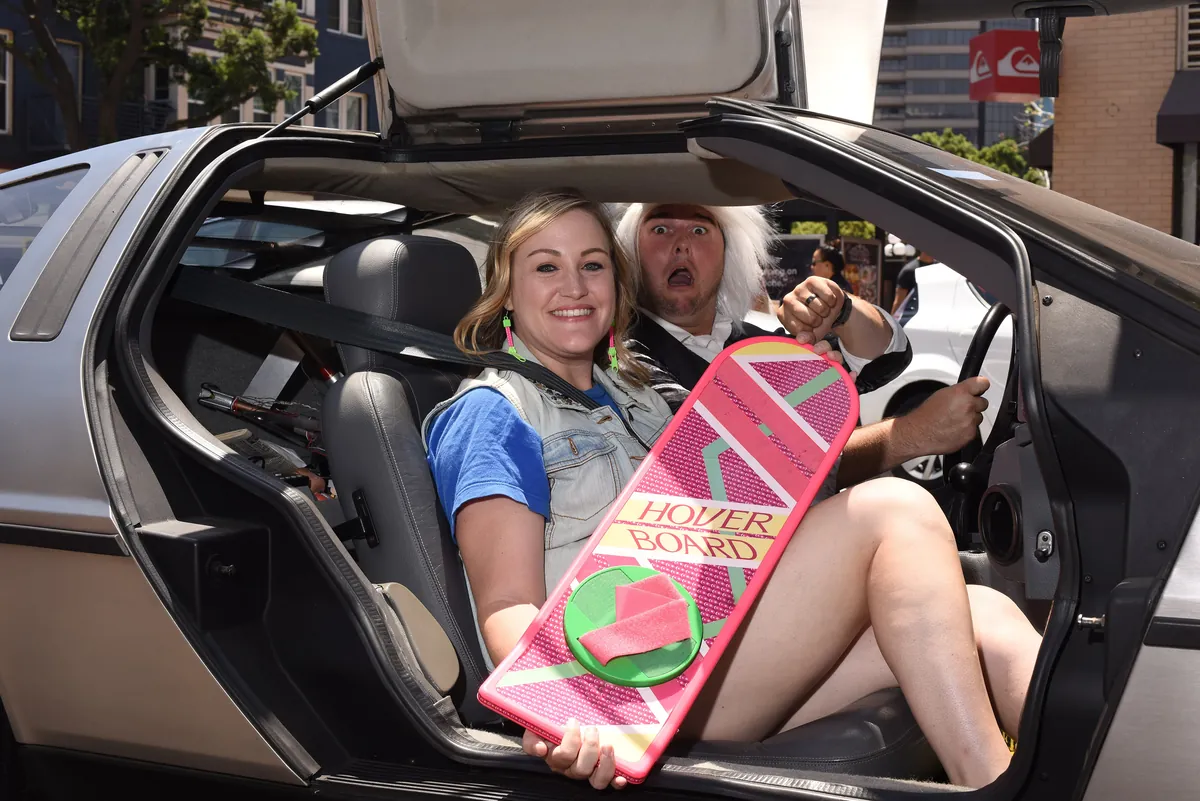
- The hoverboard. The famous floating skateboard is still mostly fiction. Lexus did show a working hoverboard in 2015, but it needed a special magnetic track to float.
Why the film was so close
It is easy to forget how different the world was in 1989. As the BBC noted, the World Wide Web was only invented in the year the film came out.
The filmmakers had no internet to guide them. Even so, they correctly guessed that screens, cameras and computers would become part of almost everything we do.
A future that is still fun
Experts writing for The Conversation and The Washington Post in 2015 had fun comparing the film to real life, and fans still mark 21 October as “Back to the Future Day”.
The film reminds us that predicting the future is hard, but imagining it is half the fun. And who knows? Perhaps one day the hoverboard will finally arrive.
Sources
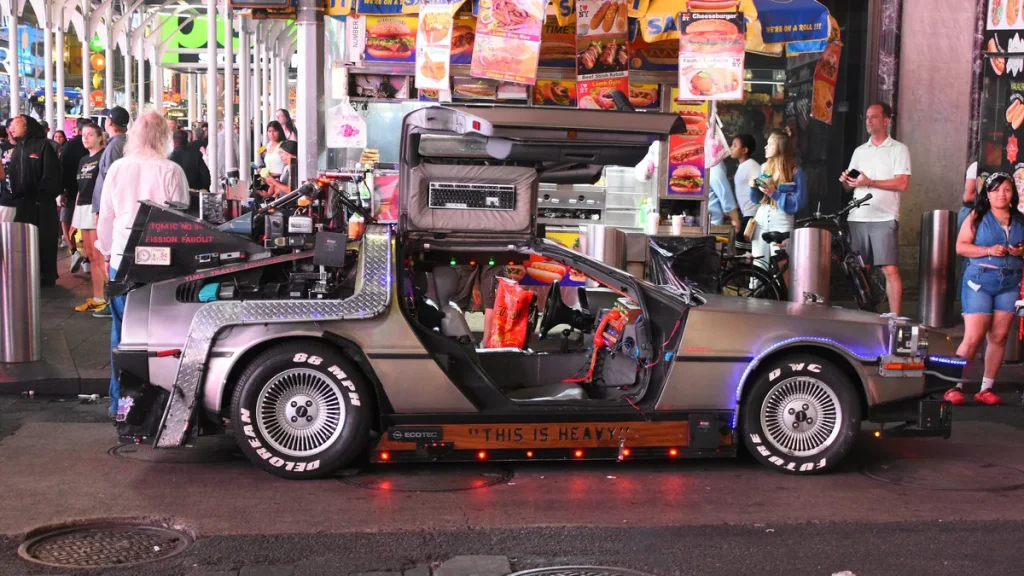
Featured image: A replica of the DeLorean time machine in Times Square, New York. Photo: Amaury Laporte / Wikimedia Commons, CC BY 4.0 (cropped and resized). Source